
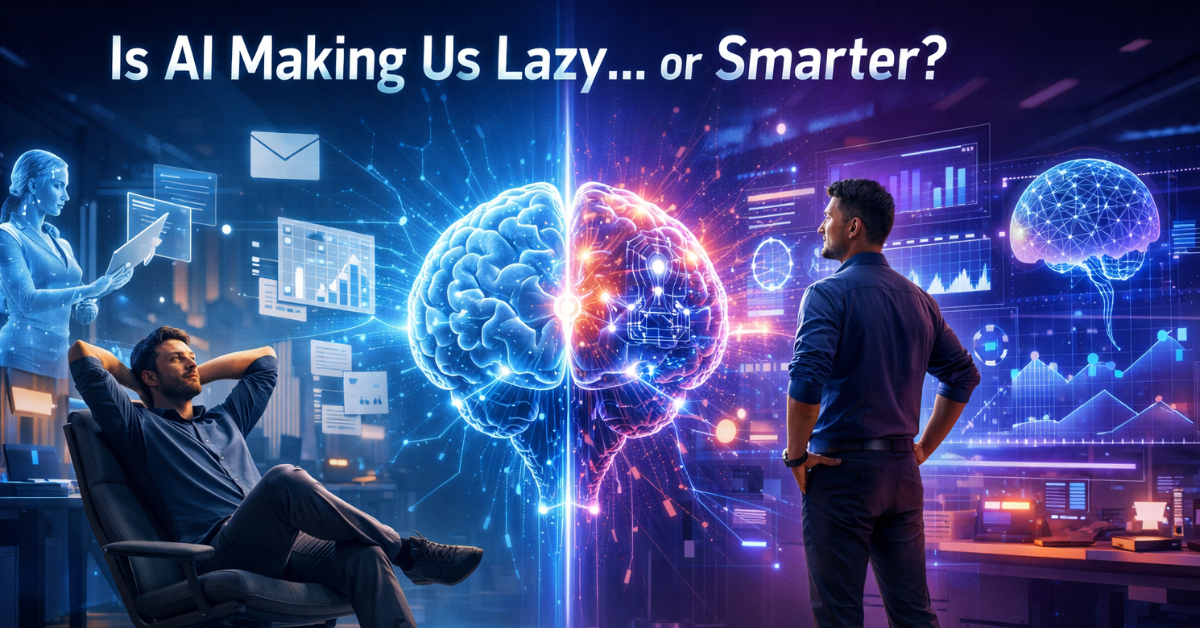
Artificial intelligence has quietly become part of everyday life. From writing emails and generating business ideas to answering complex questions in seconds, AI tools are changing how people work and think. Many professionals now rely on AI assistants for research, content creation, planning, and decision-making. This rapid adoption has sparked an interesting debate: is artificial intelligence making people mentally weaker, or is it actually expanding human capability?
This paradox sits at the center of the modern AI impact on humans. On one hand, technology is removing effort from many tasks. On the other hand, it is unlocking new levels of productivity, creativity, and efficiency. Understanding this balance is essential for individuals, businesses, and organizations trying to navigate the future of work and intelligence.
Platforms like Techietet often analyze how emerging technologies reshape human behavior and business operations. Artificial intelligence is perhaps the most powerful example of this transformation. The real question is not whether AI changes human thinking — it clearly does — but whether those changes ultimately weaken or strengthen human intelligence.
How AI Is Changing Human Thinking
Technology has always influenced how people process information. Before the internet, knowledge required hours of research in libraries or through physical documents. Today, answers appear instantly through search engines and AI systems. This shift explains how AI is changing human thinking.
Modern AI tools allow individuals to process large amounts of information quickly. Instead of spending hours gathering data, people can now focus on interpreting insights and making strategic decisions. This transformation represents a major dimension of the AI impact on humans, especially in knowledge-based professions.
For example, entrepreneurs now use AI to analyze market trends, generate business plans, or evaluate marketing strategies. Students use AI tools to understand complex concepts more quickly. Professionals rely on AI to summarize reports and extract key insights from large datasets.
Rather than replacing human thought entirely, AI often changes the nature of thinking itself. Humans are gradually moving away from routine information processing toward higher-level activities like analysis, creativity, and judgment.
AI Effects on Human Intelligence
The discussion around AI effects on human intelligence has become increasingly important. Some critics argue that AI encourages intellectual laziness by making it too easy to access answers without deep thinking. If people constantly rely on machines to solve problems, they may lose the ability to reason independently.
However, another perspective suggests that artificial intelligence can actually expand human intellectual capacity. By providing instant access to knowledge and analysis, AI enables people to explore ideas more deeply and solve problems more efficiently.
This debate highlights another layer of the AI impact on humans. Intelligence may not simply decline or improve; it may evolve. Human intelligence has always adapted alongside technology. Calculators did not eliminate mathematical thinking, and computers did not eliminate writing skills. Instead, they changed how those abilities were applied.
Similarly, AI may shift intelligence away from memorization toward interpretation and creativity. Instead of remembering every detail, humans can focus on understanding patterns, evaluating outcomes, and generating new ideas.
AI and Human Productivity
One of the most visible outcomes of artificial intelligence is the dramatic increase in AI and human productivity. Businesses around the world are using AI systems to streamline operations, automate repetitive tasks, and accelerate decision-making processes.
For example, customer service departments now rely on AI chatbots to handle common questions, allowing human agents to focus on more complex issues. Marketing teams use AI to generate campaign ideas, analyze audience behavior, and optimize advertising strategies. Developers use AI coding assistants to speed up software development.
These improvements demonstrate another powerful dimension of the AI impact on humans in the workplace. Instead of replacing workers entirely, AI often enhances human capabilities by acting as a digital collaborator.
Organizations exploring these trends frequently follow insights published on platforms like Techietet, where experts examine how businesses integrate AI tools to improve efficiency and competitiveness.
As productivity increases, the role of human workers shifts from performing repetitive tasks to managing systems, making strategic decisions, and applying creative thinking.
Artificial Intelligence and Human Behavior
Technology does more than change productivity—it also reshapes behavior. The relationship between artificial intelligence and human behavior reveals how deeply AI influences everyday decisions and habits.
Many people now consult AI tools before making choices. Entrepreneurs ask AI for marketing strategies, students request explanations for complex subjects, and professionals rely on AI-generated summaries for quick information.
This behavioral shift illustrates the growing AI impact on humans in decision-making processes. Instead of relying entirely on personal knowledge or traditional research, individuals increasingly collaborate with AI systems to explore options and evaluate outcomes.
The result is a new pattern of interaction where humans and machines work together to solve problems. Human intuition and experience combine with AI-driven analysis to create a more informed decision-making process.
AI Impact on Daily Life
Artificial intelligence is not limited to offices or research labs. It has become deeply embedded in everyday experiences, demonstrating the broad AI impact on daily life.
Many of the technologies people use daily are powered by AI:
- Navigation systems that suggest the fastest route
- Streaming platforms that recommend movies and music
- Online stores that personalize shopping suggestions
- Smart assistants that answer questions instantly
These systems constantly analyze data to improve user experiences. While many people rarely think about the algorithms behind these services, they illustrate how the AI impact on humans extends far beyond business environments.
As AI continues to evolve, its presence in daily life will likely grow even stronger, influencing how people communicate, learn, shop, and make decisions.
How AI Affects Human Brain
Researchers studying how AI affects human brain function have identified several interesting patterns. Technology often changes the way people store and process information.
For instance, humans once memorized phone numbers, directions, and detailed information. Today, many of these tasks are handled by digital tools. Instead of storing information internally, people rely on external systems to retrieve knowledge when needed.
This phenomenon is closely related to cognitive offloading, a concept discussed in psychology. It shows how technology can reshape mental processes and learning patterns.
However, the influence of AI on brain activity is not entirely negative. By automating repetitive cognitive tasks, AI allows individuals to focus on strategic thinking, problem-solving, and creative exploration.
Impact of Generative AI on Humans
One of the most significant technological developments in recent years is the rise of generative AI. The impact of generative AI on humans is particularly visible in creative and professional fields.
Generative AI systems can produce written content, design graphics, create music, generate code, and even simulate conversations. These capabilities are transforming industries such as marketing, education, software development, and media production.
However, generative AI does not eliminate the need for human creativity. Instead, it changes how creative work is performed. Humans guide the direction of ideas, refine outputs, and apply context that machines cannot fully understand.
Industry analysis from Techietet often highlights how generative AI enables businesses to scale content production while maintaining human oversight and strategic control.
AI and Critical Thinking
A common concern about AI adoption relates to AI and critical thinking. If people rely too heavily on automated answers, they may stop questioning information or exploring alternative viewpoints.
This concern is closely linked to cognitive offloading AI, a concept describing how individuals transfer mental tasks to digital systems. For example, people often depend on GPS rather than remembering routes or rely on AI-generated summaries instead of reading full reports.
While cognitive offloading can improve efficiency, excessive dependence may reduce independent analysis. To avoid this risk, users must treat AI as a tool rather than a replacement for thinking.
Effective AI users verify information, question assumptions, and interpret results critically. When used responsibly, AI can actually enhance critical thinking by exposing users to multiple perspectives and data-driven insights.
The Future of Human–AI Collaboration
The future of artificial intelligence is unlikely to involve machines replacing human intelligence entirely. Instead, it will revolve around collaboration between humans and intelligent systems.
Humans contribute qualities that machines cannot replicate easily, including empathy, ethical judgment, creativity, and contextual understanding. AI contributes speed, data processing power, and pattern recognition.
Together, they form a powerful partnership that defines the evolving AI impact on humans.
The challenge moving forward is learning how to use AI intentionally. Individuals and businesses that adopt AI thoughtfully can benefit from increased productivity, deeper insights, and expanded creative potential.
Conclusion
Artificial intelligence is transforming the way humans work, learn, and think. While some tasks have become easier and more automated, new opportunities for creativity, analysis, and innovation have emerged.
Rather than simply making people lazy, AI is redefining intelligence itself. Human thinking is shifting from memorization and routine tasks toward interpretation, strategy, and imagination.
The ultimate outcome of this transformation will depend on how individuals and organizations choose to use AI. When applied responsibly, artificial intelligence can become one of the most powerful tools for expanding human capability rather than limiting it.
Frequently Asked Questions
1. Is AI making humans less intelligent?
Not necessarily. AI automates routine cognitive tasks, but it can also expand human capabilities by providing access to knowledge, insights, and analytical tools that enhance learning and problem-solving.
2. How does AI improve human productivity?
AI improves productivity by automating repetitive work, assisting research, generating ideas, and analyzing large datasets quickly. This allows individuals and businesses to focus on strategic and creative tasks.
3. Can AI weaken critical thinking skills?
Over-reliance on AI may reduce independent analysis if users accept AI outputs without questioning them. However, when used carefully, AI can strengthen critical thinking by providing multiple viewpoints and data insights.
4. What is cognitive offloading in artificial intelligence?
Cognitive offloading refers to relying on technology to perform mental tasks such as remembering information or analyzing data. While this improves efficiency, balanced usage is important to maintain independent thinking.
5. How will AI affect the future of work?
AI will likely transform jobs rather than eliminate them completely. Many roles will shift toward strategic decision-making, creativity, and system management while AI handles repetitive or data-heavy tasks.